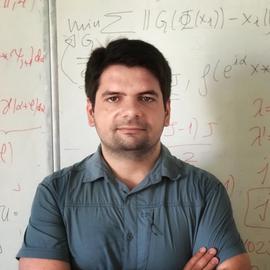
Biography
Georgios' interests focus on representations of high-dimensional data — how structure, symmetry, and uncertainty can be characterised simultaneously in ways that are both mathematically principled and empirically effective. He is interested in settings where the geometry of the data is known or partially known, and where encoding it explicitly, rather than learning it from scratch, leads to representations that are more interpretable, more stable, and more faithful to the variability present in the data. A recurring question in this work is how far one can go by designing representations from first principles — encoding what is known about the world into the structure of the model itself — and what remains that must be learned from data. He believes this question is central to the future of machine learning, both as a scientific discipline and as an engineering practice. These ideas find application across astronomy, quantum chemistry, medical imaging, and signal processing.
He is a Lecturer in the Department of Computer Science at the University of Bath, a member of the Artificial Intelligence and Machine Learning group, and a founding member of the Centre for Artificial Intelligence of the Faculty of Science. Before Bath, he held a senior researcher position at IHU Strasbourg and a postdoctoral fellowship at Institut de la Vision in Paris.
His research formation was shaped by collaborations with Prof. Jörg Lücke at the Frankfurt Institute of Advanced Studies (and later at the University of Oldenburg) on probabilistic inference and learning, Prof. Roland Memisevic at Goethe University Frankfurt on distributed representations, and Prof. Bruno Olshausen at the Redwood Center for Theoretical Neuroscience on the relationship between biological perception and high-dimensional data organisation. He received his doctorate from the University of Oldenburg, after which he worked as a postdoctoral researcher with Prof. Stéphane Mallat at École Normale Supérieure, exploring connections between physical symmetry and data representations.
Get in Touch
I am always happy to hear from potential collaborators, students at any level, and researchers from domain sciences — whether you are curious about machine learning theory, or working in a field where these ideas might find application. If any of this resonates, get in touch.
- Artificial Intelligence
- Machine Learning
- Theoretical Neuroscience
Dr. rer. nat. in Machine Learning, 2016
Carl von Ossietzky University of Oldenburg
M.Sc. in Computational Science, 2012
Goethe University Frankfurt
Diploma in Mathematics, 2008
Aristotle University of Thessaloniki
Teaching
- Frontiers of Machine Learning (CM52077) @ University of Bath 2026-Present
- Machine Learning (CM22009) @ University of Bath 2023-Present
- Machine Learning @ University of Strasbourg.
- Advanced Topics in Artificial Intelligence @ École Polytechnique.
- Machine and Deep learning @ École Polytechnique.
- Machine Learning I and II @ Oldenburg.
Featured Publications
Publications
Contact
- FirstName@exarchakis.net
- +44 (0) 1225 383440
- 1W 4.62, University of Bath, Bath, BA2 7AY
- 1 West - Fourth Floor - Room 4.62
- Tuesday 11:00 to 13:00
Wednesday 13:00 to 15:00 - Bluesky
- Telegram